
The future of web storage: from SSD to distributed Object Storage
The performance and scalability of a web project largely depend on how and where data is stored. In recent years, hosting has rapidly evolved to meet new needs for speed, availability, and growth. Understanding this evolution is key to making better technical decisions today… and anticipating those of tomorrow.
Table of Contents
From HDD to SSD: a revolution in performance
For years, the traditional hard drive (HDD) was the standard for data storage. However, its natural evolution came with SSDs (Solid State Drives), which represented a clear leap in speed, reliability, and energy efficiency.
Thanks to SSDs, loading a website went from being a slow process to being resolved in just a few moments. This had a direct impact on key aspects such as:
- User experience.
- SEO positioning.
- Energy efficiency of servers.
But technology doesn’t stop there.
Although SSDs remain a fundamental piece, they also present certain limitations:
- They are physically tied to a specific server.
- Their cost increases when handling large volumes of data.
- They do not scale as easily when a project grows quickly or globally.
And this is where the next evolution of storage comes into play: distributed Object Storage.
What is Object Storage and how does it work
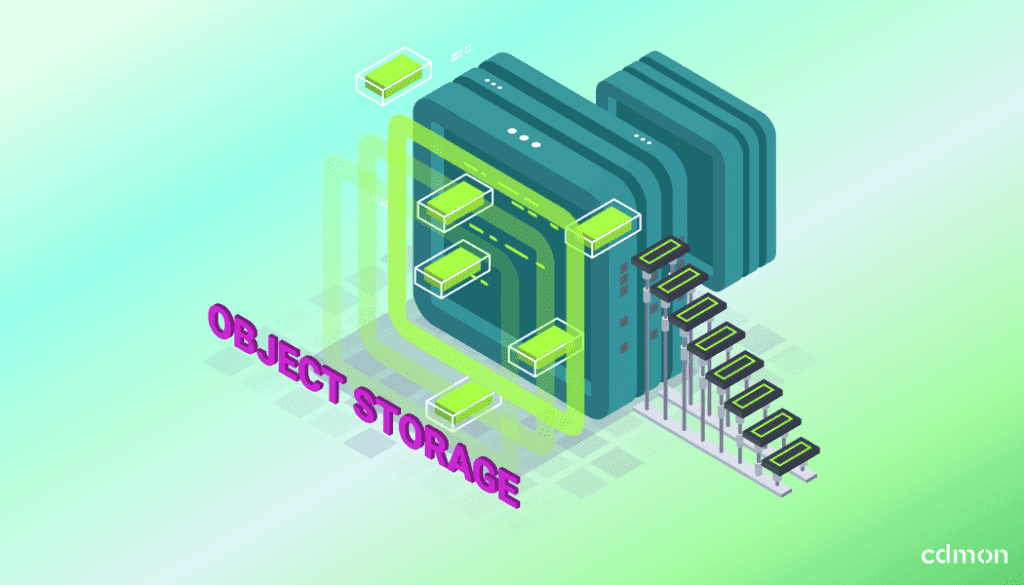
Instead of organizing files in hierarchical folders, Object Storage stores information as independent objects, each with its content, metadata, and a unique identifier.
This approach allows locating and serving any file efficiently, without relying on a rigid structure or a single physical server.
How does it differ from other methods?
- Block storage: divides data into blocks and is common in databases and operating systems.
- File storage: organizes information in a folder tree, like a traditional hard drive.
- Object Storage: manages data as autonomous objects, accessible through unique identifiers.
What does this imply in practice?
- The physical location of the data becomes irrelevant.
- Objects can be distributed across different servers or regions.
- The structure is more flexible and ready to grow.
Advantages of distributed Object Storage
This technology has become a key piece of modern hosting for a clear reason: it solves scalability and availability problems that other systems do not cover equally.
Almost infinite scalability
Object Storage allows growth without the physical limitations of a single server. If more space is needed, new nodes are added to the system without interruptions.
It is especially suitable for projects that manage large volumes of data or that grow progressively and sustainably.
High availability and redundancy
Objects are automatically replicated across different nodes or locations.
This means that even in the event of a punctual incident, the data remains available. It is a solid foundation for backups, disaster recovery plans, and environments that require high reliability.
Consistent performance
The intelligent distribution of data allows users to access content from the nearest node, reducing latency and improving load times globally.
Optimized costs
The Object Storage model is based on actual consumption:
- You only pay for the space used.
- It is easy to adapt the service to the real needs of the project.
- Costs associated with physical expansions and hardware maintenance are eliminated.
Integration with cloud ecosystems
Object Storage is designed to integrate with CMS, applications, backup systems, or data analysis solutions.
Thanks to standard APIs, like the one compatible with Amazon S3, it can be incorporated into existing workflows without complex developments.
Limitations or challenges of Object Storage
Like any technology, it also has aspects to consider.
Latency compared to local SSD
Although it is very efficient for serving static content (images, videos, documents), it is not the best option for databases or processes that require constant and real-time access.
Therefore, many infrastructures opt for a hybrid model: SSD for execution and Object Storage for data.
Need for prior integration
To take full advantage of it, it is necessary for the software or application to connect through compatible APIs or tools. Fortunately, many CMS and frameworks already offer ready-to-use integrations.
Security and permissions management
In distributed environments, it is key to correctly define access and permissions. Once configured, Object Storage offers a stable and secure environment.
Use cases of Object Storage
Some of the most common uses of this technology are:
- Automatic backups independent of the main server.
- Disaster recovery systems.
- Storage of multimedia content and documents.
- Hosting of static sites along with CDN.
- Processing large volumes of data for analysis or artificial intelligence.
How Object Storage is transforming hosting
The way data is stored and served has changed, and modern hosting evolves with it.
Hybrid hosting the current model
The most common combination today is:
- NVMe SSD for running applications, CMS, and databases.
- Object Storage for static content and large volumes of information.
This approach improves performance and allows for more flexible and efficient management.
Sustainability and regulatory compliance
European providers, like cdmon, are committed to distributed infrastructures that:
- Comply with regulations such as ENS, ISO, and data protection.
- Reduce dependence on centralized data centers.
- Improve the energy efficiency of the entire infrastructure.
cdmon and the future of web storage
At cdmon, we continue to evolve our infrastructure to offer solid solutions tailored to real projects:
- Latest generation NVMe SSDs.
- Distributed backup systems.
- Scalable and secure cloud infrastructures.
The goal is clear: to bring advanced technology closer without adding unnecessary complexity.
Conclusion
The evolution of hosting is clear. First, there was the leap from HDD to SSD, and now we are moving towards hybrid and distributed models.
Object Storage does not replace SSD, it complements it. It is designed to meet current needs for scalability, availability, and data volume.
In summary:
- SSDs marked a before and after in performance.
- Object Storage provides scalability, resilience, and efficiency.
- The future of hosting combines both approaches.
And at cdmon, we are already prepared to walk that path with you.
There is no turning back: the future of hosting is hybrid and distributed. We have moved from HDD to SSD, and now it’s time to take the next step.
Object Storage does not replace SSD, it complements it. It offers a solution designed for the era of big data, online video, mobility, and global scalability.

By: Miriam Chica
She is part of cdmon's development team. Her background combines experience in technical support and software development, allowing her to clearly explain how technologies such as DNS, servers, and Internet security work. On the cdmon blog, she shares content that helps readers understand technical concepts in a clear and accessible way.
You can learn more about her background on LinkedIn


