
Security 2026: Zero Trust, early detection, and compliance for your web
Web security is evolving faster than ever. In just a few years, we have gone from protecting simple static sites to defending complex, distributed digital ecosystems connected with multiple external services. In 2026, threats no longer only seek technical vulnerabilities: they target identities, data flows, providers, and any weak point in the digital chain.
Therefore, concepts like Zero Trust, AI-based early detection, or advanced regulatory compliance are no longer optional but have become the minimum standard. In this article, we analyze how web security changes in 2026 and what measures you should apply to protect your site, your users, and your business.
Table of Contents
Introduction: the evolution of digital security
In 2026, web security has become a fundamental pillar for any digital project. The increasing sophistication of attackers, the automation of cybercrime, and the massive use of generative AI have created a scenario where threats evolve faster than many traditional defenses.
Current cyberattacks not only increase in number but also in precision: from advanced AI-generated phishing, capable of imitating real users, to next-generation DDoS attacks, ransomware specifically targeting SMEs, or the exploitation of misconfigured APIs and microservices. A breach is no longer just a technical problem but becomes a real risk to reputation, revenue, and legal compliance.
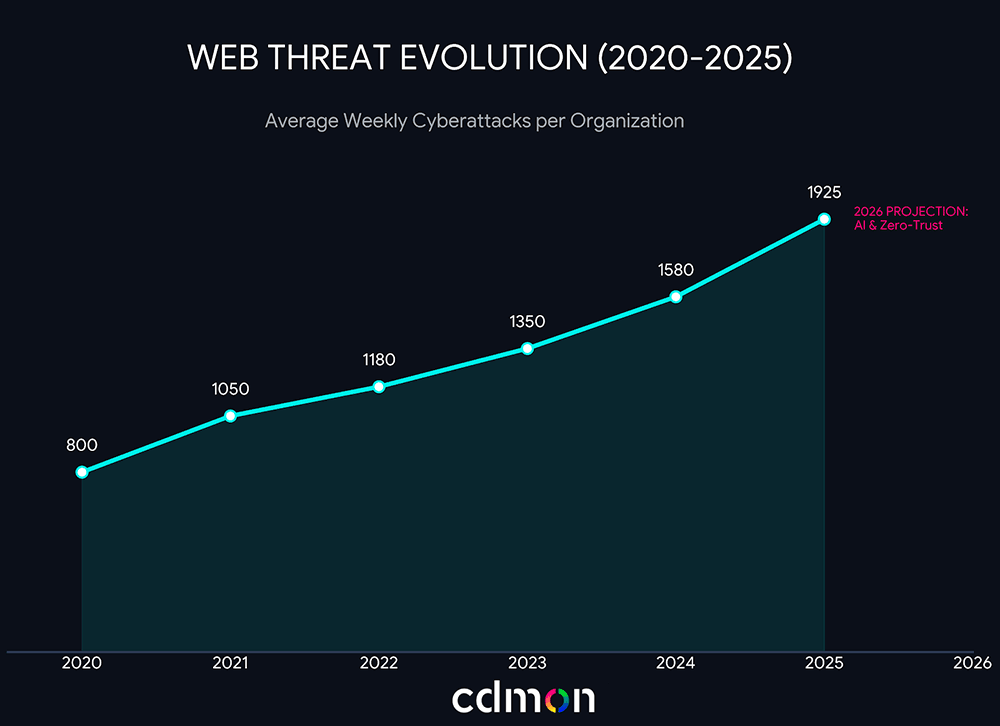
In this context, hosting takes on a critical role. It is no longer just the place where a website is hosted, but the foundation on which the most important defenses are built. A secure hosting must offer continuous monitoring, segmented infrastructure, resilient backups, granular access controls, and robust encryption. All of this, backed by recognized security standards, is key to ensuring data protection.
Traditional perimeter security models are a thing of the past. This is where the need to adopt Zero Trust arises, an approach that redefines how to protect applications and data in 2026 and is based on a fundamental idea: do not trust any access, user, or device by default.
The Zero Trust model: zero trust by default
What is Zero Trust and why has it become the current standard
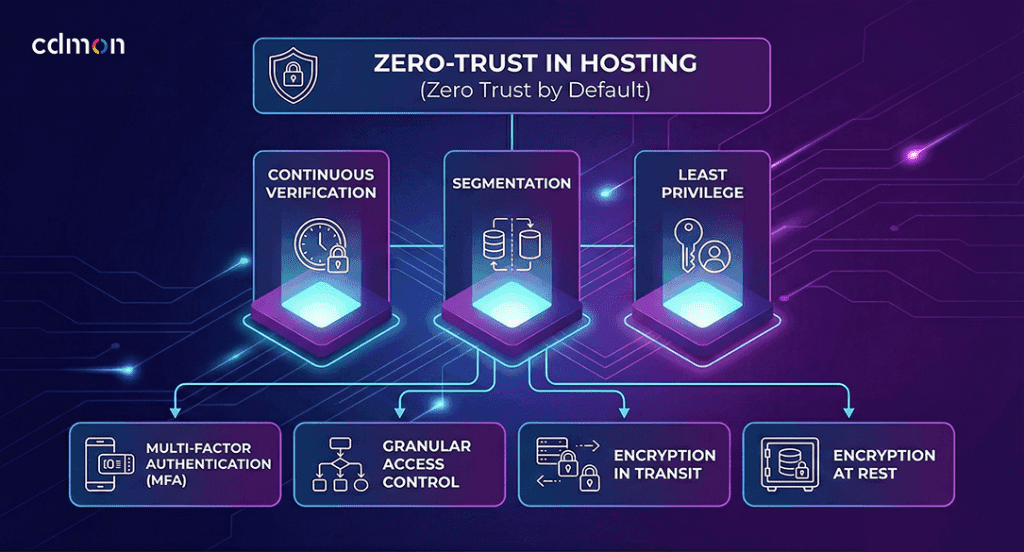
Zero Trust is based on a clear premise: no access is trusted by default, regardless of its origin. Every user, device, or request must be continuously validated, minimizing lateral movement in case of a breach and significantly enhancing the security of digital environments.
This approach has become the standard in 2026 because it directly addresses current threats, such as:
- Increasingly frequent insider attacks.
- Credential leaks, a common intrusion vector.
- Complex digital supply chains, with multiple intermediaries.
- Third-party integrations, which expand the attack surface.
Key principles: continuous verification, segmentation, least privilege
The pillars of Zero Trust are:
- Continuous verification: every action is checked, not just the login.
- Infrastructure segmentation: “Microzones” are created to limit the scope of an attack.
- Least privilege access: each user receives only the essential permissions.
Practical application in hosting and web environments
In a modern hosting environment, Zero Trust translates into tangible measures such as:
- Encryption in transit and at rest: forced HTTPS, advanced SSL certificates, and encrypted databases.
- Multifactor authentication (MFA): essential in control panels, FTP, SSH, and content managers.
- Granular access control: segmented roles, temporary permissions, restrictions by IP or project.
Early detection and automated response to threats
How AI and machine learning transform security
In 2026, AI and machine learning are the main engines of modern web security. Generative AI has raised the level of attacks—creating indistinguishable phishing emails, automating exploits, and analyzing systems to identify flaws—but it has also greatly strengthened defenses.
Protection systems are now capable of recognizing anomalous traffic patterns, detecting unusual accesses, or identifying behaviors that do not fit the usual activity of a site. Instead of reacting after an attack, AI allows anticipation: a sudden increase in requests, a strange data flow, or repeated authentication attempts are detected in seconds, generating alerts or automatically acting to block the threat.
Real-time monitoring: logs, firewalls, IDS/IPS
Continuous monitoring has become an essential requirement for any secure hosting. It is not just about “seeing” what happens, but about correlating events, understanding their context, and acting immediately.
A complete security environment integrates:
- WAF (Web Application Firewall) that inspects and filters attacks like SQL injection or XSS.
- Centralized and correlated logs, which allow reconstructing any incident.
- Behavior-based IDS/IPS, capable of detecting intrusions that do not match known signatures.
- Real-time alerts, which warn even of activities that could be suspicious in the future.
This continuous visibility turns monitoring into the first defensive shield against complex attacks.
If you want to see how these measures are applied in a professional hosting environment, here is a complete guide to the security technologies we use at cdmon.
Proactive detection strategies against malware, DDoS attacks, or vulnerabilities
Early detection is not limited to observation; it involves reacting even before an attack materializes. The most effective strategies include:
- Malware scanning with heuristic and predictive analysis, which identifies suspicious files even if they are not cataloged.
- Scalable DDoS mitigation, adapted to the size of the attack and active from the first second.
- Virtual patches, which protect vulnerable applications even before the developer releases an update.
- Automatic blocking of anomalous patterns, such as IPs with a bad reputation or request sequences that are too fast.
This approach drastically reduces blind spots and minimizes the impact of any intrusion attempt.
Example: how hosting with advanced detection reduces reaction time
In hosting without intelligent monitoring, a breach can remain invisible for hours or even days, enough time to compromise data, manipulate files, or deploy malware.
With advanced detection systems, that time is reduced to seconds:
- a malicious script is blocked before execution,
- a brute force attempt triggers an immediate alert,
- a traffic anomaly automatically activates containment measures.
This reaction margin can make the difference between an isolated incident and a serious attack with legal and economic consequences.
Compliance and standards: the basis of secure hosting
Key regulations in 2026
In an increasingly regulated digital environment, regulatory compliance has become a fundamental pillar of web security. It not only ensures data protection; it also ensures that a hosting provider has mature, audited, and transparent processes. In 2026, the most relevant regulations are:
- ENS (National Security Scheme): is the Spanish framework that establishes the minimum requirements to protect information processed by public administrations and technology providers. It includes access controls, traceability, encryption, continuity, incident management, and physical security. cdmon is certified in the ENS Medium category.
- ISO 27001: is the international standard that defines how security should be managed through an ISMS (Information Security Management System). It covers internal policies, access controls, risk analysis, audits, and continuity plans. It is the most globally recognized standard for ensuring mature security management.
- GDPR (General Data Protection Regulation): regulates the processing of personal data in the EU. It requires security by design, transparency, data minimization, and technical measures to prevent breaches. It affects any website that manages information from European users.
- NIS2 (Network and Information Security): is the European Directive on Network and Information Security, aimed at raising the level of cybersecurity in all EU Member States. It seeks to ensure that essential services and digital providers (such as hosting, cloud, SaaS, telecommunications, etc.) operate with high levels of security and resilience.
Comparison of key regulations
| Aspect | ENS | ISO 27001 | GDPR | NIS2 |
|---|---|---|---|---|
| Scope | Spain. Mandatory for public systems and providers; reference for private. | International. Applicable to any organization that wants to certify security. | European Union. Mandatory if personal data is processed. | European Union. Mandatory for digital providers and essential sectors. |
| Objective | Protect services and data through technical and organizational controls. | Manage security through a risk-based ISMS. | Protect users’ rights and privacy. | Increase resilience and response capacity to cyber incidents. |
| Nature | Technical standard with mandatory requirements according to category. | Voluntary certifiable standard, widely extended globally. | Mandatory legal regulation throughout the EU. | Mandatory legal directive for defined sectors. |
| Levels / Categories | Low, Medium, and High categories according to impact. | No levels; audit determines compliance. | No levels, but requires measures proportional to risk. | No levels; establishes minimum obligations for essential and important entities. |
| Key controls | Access, traceability, encryption, continuity, physical security. | Policies, risk analysis, organizational and technical controls. | Consent, minimization, privacy by design, user rights. | Risk management, supply chain, incident notification, continuity. |
| Audit | Mandatory periodic external audit. | Internal and external audits to maintain certification. | Supervision by data protection authorities. | Government supervision; entities must demonstrate compliance. |
| Sanctions | No direct sanction applies, except in public contracts. | No direct sanctions; reputational impact. | High fines (up to €20M or 4% of global turnover). | Very high sanctions for security and notification non-compliance. |
| Recommended for | Public projects, critical services, companies with high demand. | Organizations needing a solid and certifiable framework. | Any website or company processing personal data. | Digital providers, hosting, SaaS, telecommunications, essential services. |
How they ensure data protection and service continuity
These regulations are not just theoretical frameworks; they involve practical controls that enhance the security of hosting and any digital project hosted on it. Together, they ensure that:
- Security is applied by design and by default.
- There are continuity and recovery plans tested periodically.
- Accesses are controlled and audited with complete traceability.
- Data is stored and managed with policies of integrity, availability, and confidentiality.
- The organization operates under documented processes, reviewed and auditable.
- Risks and vulnerabilities are constantly evaluated.
- Incidents are managed following formal procedures and mandatory notifications (especially under NIS2).
The result is a more stable, predictable, and resilient environment against advanced threats.
The value of choosing a certified provider
Selecting a provider that works under ENS, ISO 27001, GDPR, and aligned with NIS2 is not a minor detail: it is a guarantee that security is managed professionally and continuously. A provider with certifications and compliance:
- Reduces legal risks and helps companies meet their own obligations.
- Provides transparency, as it is subject to periodic external audits.
- Demonstrates operational maturity and a real security culture.
- Facilitates internal or external audits in organizations that must also meet standards.
- Increases the resilience of digital services against complex incidents.
In summary, certification is not a seal; it is a commitment.
cdmon as an example of compliance and transparency
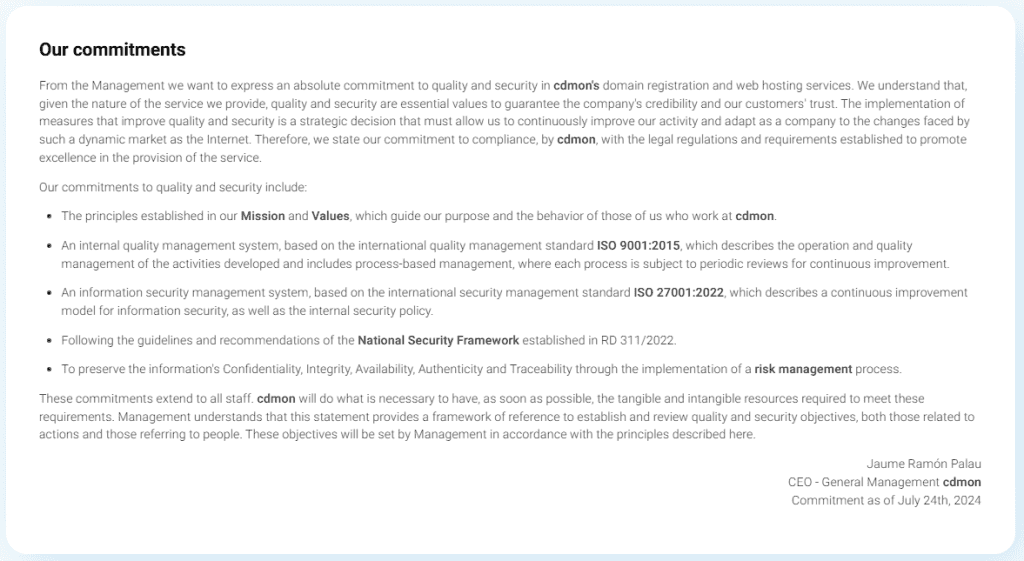
At cdmon, regulatory compliance is part of the service architecture. We have ISO 27001 certification, ENS Medium category, processes aligned with GDPR, and adapted to the obligations of NIS2 as a digital provider within the European ecosystem.
This allows us to offer a secure, stable, and verifiable environment, with advanced controls, continuous monitoring, data protection policies, and incident management processes designed to respond to the challenges of 2026.
Comprehensive web security: best practices and recommendations
The hosting infrastructure is only part of the security. The other half depends on the actions and habits adopted by each project. In 2026, these are the essential practices to ensure complete protection and reduce risks in a real way.
Regular updates and patches
The most frequent attacks continue to exploit known vulnerabilities in CMS, plugins, and frameworks. Keeping everything updated—including the server itself—remains the most effective measure to prevent intrusions. A well-managed patch cycle drastically reduces the attack surface and prevents automated exploits.
Automated and external backups
Redundancy is essential in the face of failures, human errors, ransomware, or updates that do not go as expected. A modern backup system must:
- run automatically,
- store historical versions,
- allow quick restorations,
- and be maintained in infrastructure separate from the main server.
If you want to strengthen this part, you can internally link to hosting services with automated backups.
SSL certificates and forced HTTPS
Encryption is mandatory: it protects data in transit and improves user trust. Additionally, Google penalizes websites without HTTPS. Activating an SSL certificate and forcing HTTPS prevents mixed or insecure accesses.
Review of permissions and access credentials
Accesses are one of the main sources of incidents. Reviewing permissions, removing inactive users, changing passwords periodically, and activating MFA in panels, FTP, SSH, or content managers is essential. Even with good hosting, a weak password can compromise an entire project.
Education and awareness
An important part of breaches starts with human errors: fraudulent links, infected files, or unsafe practices. Training teams in phishing detection, digital hygiene, and best practices significantly reduces internal incidents and strengthens the overall security posture.
Future of web cybersecurity
The pace of evolution of cybersecurity is faster than ever. The arrival of generative AI, the expansion of edge computing, and the tightening of regulations are transforming how websites and digital infrastructures are protected.
Generative AI and predictive detection
Advanced security systems will not only react to an attack; they will anticipate it. Thanks to AI models capable of analyzing global patterns, anomalous traffic, access attempts, and attack trends, predictive detection will allow identifying vulnerabilities even before they are exploited. This technology will turn monitoring into a proactive, not reactive, system.
Integration of Zero Trust with multi-cloud and edge computing
As websites are distributed among multiple cloud providers, microservices, and edge nodes, security must adapt in real-time to each environment. Zero Trust will evolve into a dynamic model where each user, process, or device is continuously validated, regardless of where it connects from. This will be key to protecting complex and distributed architectures.
Evolution of digital compliance in Europe
Regulations like NIS2, GDPR, or future updates of ISO 27001 will expand security, risk management, and incident notification requirements. Obligations for technology providers—including hosting and cloud services—will be especially tightened, requiring them to demonstrate more robust processes, greater traceability, and active supply chain management.
Conclusion
Web security in 2026 no longer depends solely on specific tools; it requires a continuous strategy based on three fundamental pillars.
- Zero Trust, which eliminates implicit trust and reinforces continuous verification of identities, accesses, and services.
- Early detection, driven by AI and advanced monitoring, capable of anticipating attacks and responding in seconds.
- Compliance, where regulations like ENS, ISO 27001, GDPR, and NIS2 ensure that providers work under audited, solid, and resilient processes.
This comprehensive approach allows companies to reduce risks, protect their data, and operate with greater continuity. In an environment where threats evolve every week, security ceases to be a static product and becomes a living process, requiring constant updating, innovation, and collaboration with trusted providers.
Digital security is not a product you buy once; it is a continuous process that evolves with your project. Protect your web with certified hosting and continuous monitoring with cdmon.

By: Miriam Chica
She is part of cdmon's development team. Her background combines experience in technical support and software development, allowing her to clearly explain how technologies such as DNS, servers, and Internet security work. On the cdmon blog, she shares content that helps readers understand technical concepts in a clear and accessible way.
You can learn more about her background on LinkedIn


