
What are zero-click results in SEO
Recently, Google has thoroughly changed the way users interact with search results. It is increasingly common to find direct answers, informational panels, AI-generated blocks, or featured snippets that resolve the query without the need to visit any website.
This phenomenon—known as zero-click SEO—has transformed traditional metrics: pages that continue to rank the same notice drops in CTR, informational keywords that previously brought thousands of visits now generate only impressions… and the arrival of Google SGE (Search Generative Experience) further accelerates this change.
In this article, we analyze what exactly zero-click results are, why they are growing, and how you can adapt your SEO 2026 strategy to remain visible, relevant, and competitive in the era of instant answers.
What zero-click means in SEO
Definition and context
In SEO, we discuss zero-click results when a user gets the answer directly on the results page and does not need to click on any organic result.
Google responds to the search intent from the SERP itself with enriched snippets, interactive modules, or AI-generated answers (like SGE, Search Generative Experience).
In other words, Google resolves the query before the user reaches your website.
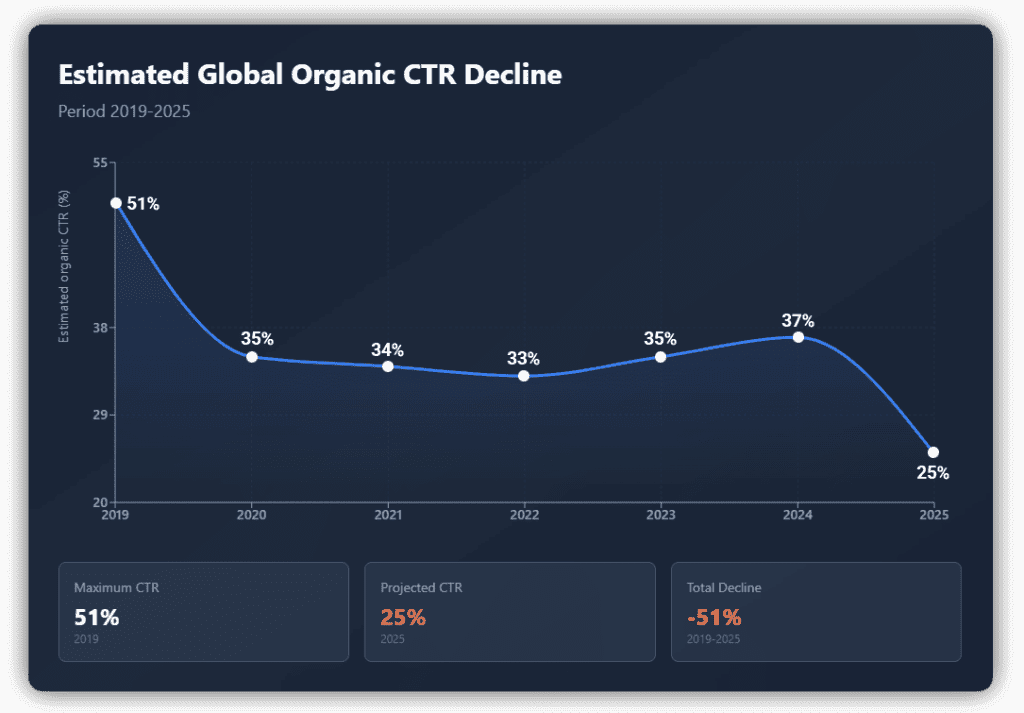
This trend continues to grow and directly affects the organic CTR and the volume of web traffic received even by the top positions.
Practical examples
The most common cases of “zero-click SEO” include:
- Featured Snippets
- Knowledge Panels (Knowledge Graph)
- People Also Ask (PAA)
- Quick converters (currencies, units, time, calculators)
- Contextual information: weather, time, definitions, maps
- Local results without needing to visit the website
- AI-generated answers thanks to Google SGE
Why the number of zero-click results has increased
There are four key factors:
- The arrival of Google SGE: generative search uses AI to display complete answers, syntheses, and recommendations without needing to visit any website.
- Expanding generative AI: Google Bard/Gemini and the integration of generative models directly respond to complex questions.
- The growth of voice search: assistants prioritize concise answers, generally zero-click.
- Better user experience (UX): Google has reinforced its main goal: to offer the best answer in the shortest possible time.
How zero-click results affect organic traffic
Reduction of clicks on informational queries
Informational searches (“what is”, “how does it work”, “when does it start”, “how many years…”) are the most affected.
In these, the user usually settles for the snippet’s answer.
This has caused a drop in organic CTR, even in top positions.
Increase in visibility without direct traffic
If you appear in a snippet or featured panel, your brand gains visibility… but not always traffic.
The user sees your content, recognizes your brand, and identifies you as a reliable source, but does not visit your website.
Even so, generating “presence” in these spaces is key for future SEO.
Unequal impact: branded vs. non-branded keywords
- Branded: tend to maintain CTR because the user wants your website.
- Non-branded: are the most affected, as Google offers complete answers.
Drop in average CTR in positions 1-3
Most common types of zero-click results
Featured Snippets
The best known:
Paragraph, list, or table that appears above result 1.
Ideal for short-answer searches: 40–60 words.
People Also Ask (PAA)
Related questions that show summarized answers.
They have gained much relevance thanks to generative AI.
Knowledge Panels (Knowledge Graph)
Shows consolidated information about an entity: company, person, place, etc.
Ideal for reinforcing branding.
Maps and local results
Google Maps can resolve a local intent without the user needing to visit the website.
Rich Results
Enriched results based on structured data:
- FAQ
- Prices
- Reviews
- Recipes
- HowTo
- Events
Generative results (SGE and AI answers)
Google generates a content block that mixes text, links, recommendations, and additional context.
Strategies to leverage zero-click results
Optimize to appear in snippets, not to avoid them
Snippets are not “blocked”. They are earned.
To increase your chances:
- Use H2/H3 headings with questions.
- Answer in brief paragraphs (40–60 words).
- Add lists and direct examples.
- Use phrases like “In summary”, “The key is…”.
Implement structured data (Schema.org)
Schemas help Google understand your content and position it for zero-click results:
- FAQPage
- HowTo
- Article
- Product
- LocalBusiness
- BreadcrumbList
Example of FAQ schema (JSON-LD):
{
"@context": "https://schema.org",
"@type": "FAQPage",
"mainEntity": [{
"@type": "Question",
"name": "What is a zero-click result",
"acceptedAnswer": {
"@type": "Answer",
"text": "A zero-click result is one where the user gets the answer on Google without needing to enter any web page."
}
}]
}Strengthen E-E-A-T
Google prioritizes content created by:
- Real experts
- With verifiable experience
- Demonstrated authority
- Transparency (author, date, sources)
Include calls to action within visible snippets
If the snippet is displayed, use phrases like:
- “Discover more in our complete guide…”
- “Check out the advanced examples…”
- “Expand this explanation with our full tutorial…”
Create content that expands the value of the direct answer
If the snippet answers the question, your content should provide something more:
- Use cases
- Comparisons
- Templates
- Videos or downloadable resources
- In-depth explanations
How to measure the impact of zero-click SEO
Review of CTR in Search Console
Analyze:
- Drop in CTR in informational searches
- High impressions but few clicks
- Variations after Google updates
Analysis of impressions vs. click
If the volume of impressions rises but clicks do not, you are likely facing zero-click queries.
Segmentation by search intent
Divide your keywords into:
- Informational
- Transactional
- Navigational
The impact will not be the same in each group.
Use of tools like Ahrefs, Semrush, or Similarweb
These tools allow you to detect:
- Keywords with featured snippet
- PAA
- Estimated CTR drop
- Competitors already occupying zero-click results
Future of SEO in the era of instant answers
Google generative search (SGE) and AI summaries
SGE will change how results are consumed.
AI synthesizes information, but still needs reliable sources.
Your priority should be to become one of those sources.
How sites can gain visibility without clicks
Future visibility will be hybrid:
- Impressions in snippets
- Presence in knowledge panels
- Mentions in SGE
- Recognizable brand
The key is to be read, even if not always visited.
Branding and user retention strategies
The brand will be more important than the click:
- Recognizable naming
- Expert content
- Visible author
- Well-aligned social media
Multimodal content
Google prioritizes content:
- Text + video
- Animations
- Interactive images
- Integrated audio
The rich and useful experience (beyond the quick answer) will have an advantage in SEO 2026.
Conclusion
Zero-click results are not a threat: they are a natural evolution of SEO. The user seeks immediate answers, and Google has adapted to offer them.
Your goal is no longer just to get clicks, but to be the source that Google uses to resolve those answers. You gain authority, visibility, and recognition, even without direct traffic.
Adapting does not mean losing traffic, but repositioning to continue growing in an environment where generative AI and instant answers will mark the path of future SEO.
Optimize your website with structured content and a high-performance hosting with cdmon. More speed, more visibility, more opportunities.

By: Marina Moreno
She works on cdmon's marketing team, creating content that helps businesses, professionals, and creators better understand the world of hosting, domains, and online presence. She is especially interested in how artificial intelligence, search engines, and digital communication are evolving, and enjoys translating technical concepts into language that anyone can understand.
You can learn more about her background on LinkedIn


